Navigation

Content

Welcome to the official site of Ratibořice

 
... If you know then which sweet image it was, to which I am devoted still, as if it were a sweet enchantment, for which I always longed, as if for a lost paradise? Do you know it? My beautiful youth, the sweet seclusion in which I lived, the simple upbringing I experienced - for a short while the ideal girl’s life - that pure beautiful poetry, the paradise of our life – for so it was! None of you see sweet Ratibořice as beautifully as I! You see in it the prose of reality, while for me it stayed a paradise! I still see every stone, every flower as they were when I was a small girl.
Božena Němcová,
letter to her sister Adéle
21st November 1856


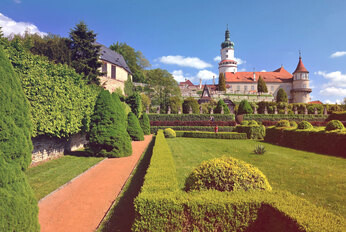
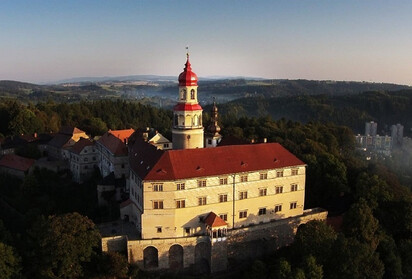
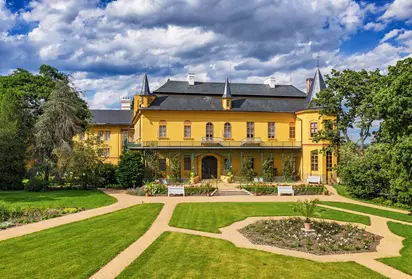
      This house was not the first aristocratic seat in Ratibořice. A written record exists from 1388 about a tower house with a farm yard and village in the possession of the knight Vaňek of Žampach and Ratibořice. It seems the deserted and uninhabited tower house deteriorated before the end of the 16th century; however the village and farmyard remained. From this date Ratibořice became part of the Náchod estate, which during the course of the Thirty Years War became the property of the Italian princely family of Piccolomini. Prince Lorenzo had a Late Baroque house constructed in the Ratibořice courtyard in the years 1702–8, as both a summer and hunting seat, as well as a small formal garden in a floodplain at the foot of a bank.

      However the house entered the public conciousness via its appearance after the Neo-Classical and Empire alterations, which took place in the first third of the 19th century  under  (Katharina)  Wilhemine, Duchess of Sagan, Princess of Courland, known as ‚her ladyship´ from the literary work Babička (Grandmother) by the writer Božena Němcová, but also from the writings of Alois Jirásek. To the adaptation of the house for her annual summer residencies and for receiving important guests, this beautiful duchess also added extensive work and alteration of the wider landscape along the Úpa river, renamed the Babiččino (Grandmother’s) Valley already by the end of the 19th century. She had the original farmyard pulled down to create space for the creation of a new English-style park and new, so-called contemporary farmyard alongside the guesthouse were built around 1811, not far from the house. A new orangery (´the Pineapple House´) was completed at the edge of the park by 1830. The older formal garden under the house gave way to the creation of a very extensive, new natural landscape park, which includes further historic buildings, for example the Hunting and Tea Pavilion, Pub, Watermill and Mangle, and the Old Bleaching House. The scheme that Duchess Wilhemine conceived and is imprinted on the landscape on the part of the river between Česká Skalice and the town of Slatina, has been basically preserved to this today and is valued for its cultural signficance. Nothing fundamental has changed despite more than a century of ownership and management by owners from the German princely family of Schaumburg–Lippe until 1945. 
 
... It is said, my dear Wilhemine, that Ratibořice will be written into the pages of history. This place is becoming the diplomatic centre of Europe at a time when poor Europe has become a collecting point for all the burdens of the world ...
         Prince Klemens von Metternich,
Chancellor of Austria,
letter to the Duchess of Sagan,
1813
                                                                                             
... A masterwork. Imagine a small country seat, beautiful in profile, jewel case in furnishings, sitting on a hill, which creates one side of a sweet valley;there are meadows throughout the whole vallery, through which flows the delightful little Úpa river ...
 
         Prince Klemens von Metternich,
letter to his wife Marie Eleonora,
1813